EXPONENTS AND LOGARITHMS
A.EXPONENTS
1. Definition
Exponents (or Indices) show how many times a number is multiplied by itself.
example;
$\boldsymbol{x^{3} = x \cdot x \cdot x}$
2. Basic Laws of Exponents
(i) Multiplication Law
To multiply powers with the same base, keep the base and add the exponents.
$\boldsymbol{x^{a} \cdot x^{b} = x^{a+b}}$
(ii) Division Law
To divide powers with the same base, keep the base and subtract the exponents.
$\boldsymbol{x^{a} \div x^{b} = x^{a-b}}$
(iii) Power of a Power Law
To raise a power to another power, keep the base and multiply the exponents.
$\boldsymbol{(x^{a})^{b} = x^{ab}}$
(iv) Power of a Product Law
When a product is raised to a power, apply that power to every factor inside the parentheses.
$\boldsymbol{(xy)^{a} = x^{a}y^{a}}$
(v) Zero Exponent Law
Any non-zero number raised to the power of zero is always equal to 1.
$\boldsymbol{x^{0} = 1}$
(vi) Negative Exponent Law
A negative exponent indicates the reciprocal (one over) of the base with a positive exponent.
$\boldsymbol{x^{-a} = \frac{1}{x^{a}}}$
(vii) Fractional Exponent Law
The denominator of a fractional exponent indicates the root, while the numerator indicates the power.
$\boldsymbol{x^{\frac{1}{2}} = \sqrt{x}}$
$\boldsymbol{x^{\frac{m}{n}} = \sqrt[n]{x^{m}}}$
3. Examples
(i) $\boldsymbol{x^{2} \cdot x^{3} = x^{5}}$
(ii) $\boldsymbol{x^{6} \div x^{2} = x^{4}}$
(iii) $\boldsymbol{(x^{2})^{3} = x^{6}}$
(iv) $\boldsymbol{x^{-2} = \frac{1}{x^{2}}}$
(v) $\boldsymbol{x^{\frac{1}{2}} = \sqrt{x}}$
Sample Questions
Attempt the following Questions:
(i) Simplify: $\boldsymbol{x^{2} \cdot x^{5}}$
(ii) Simplify: $\boldsymbol{x^{6} \div x^{2}}$
(iii) Simplify: $\boldsymbol{(x^{3})^{2}}$
(iv) Simplify: $\boldsymbol{x^{-3}}$
(v) Simplify: $\boldsymbol{x^{\frac{1}{2}}}$
Check The Answers Below:
TAKE NOTE:
- Bases must be identical: You can only add or subtract the powers if the main numbers (the bases) are exactly the same.
- Addition is not multiplication: There is no rule to simplify exponents when you are adding or subtracting terms; index laws only apply to multiplication and division.
- Zero power equals one: Any number (except zero) raised to the power of zero will always be 1, no matter how large the number is.
- Negative powers make fractions: A negative sign in the exponent does not make the number negative; it simply tells you to flip the number into a fraction.
B. LOGARITHMS
1. Definition
A logarithm tells us the power to which a base must be raised to get a number.
2. General Form
$\boldsymbol{\log_{a}(b) = x}$
where :
- a = Base
- x = Logarithm (Result)
- b = Argument
The above logarithm is read as:
This is read as : Log "b" base "a" is equal to "x".
MEANING : "x" is the "Logarithm of Argument "b" base "a".
Example
$\boldsymbol{\log_{10}(100) = 2}$
This is read as : Log "100" base "10" is equal to "2".
Meaning ;
$\boldsymbol{10^{2} = 100}$
This is now in Exponent Form.
3. Changing Between Forms
Logarithm Form can be changed into Exponent Form and vice versa :
(i) Changing From Logarithm Form to Exponent Form
When changing Logarithm Form to Exponent Form :
- The "base" remains constant (It does not change)
- The "Logarithm" becomes the "Power"
- The "Argument" becomes the "Result"
In simple terms :
We simply swap the "Argument" and the "Logarithm", then remove log.Example
Convert the following Logarithm Form to Exponent Form :$\boldsymbol{\log_{a}(b) = x}$
In this Logarithm :
- a = Base
- x = Logarithm (Result)
- b = Argument
When converted it to Exponent Form, it becomes :
$\boldsymbol{a^{x} = b}$
Where :
- a = Base
- x = Power (Exponent)
- b = Result
(ii) Changing From Exponent Form to Logarithm Form
When changing an Exponent Form to logarithm form :
- The "base" remains constant (It does not change)
- The "power" becomes the "Logarithm" (Result)
- The "Result" becomes the "Argument"
In simple terms :
We simply swap the "Power" and the "Result", then introduce log.Example
Convert the following Exponent Form to Logarithm Form :
$\boldsymbol{a^{x} = b}$
In this Exponent Form :
"a" is the "base"
"x" is the "power"
"b" is the "result"
When converted it to Logarithm Form, it becomes :
$\boldsymbol{\log_{a}(b) = x}$
Where :
- a = Base
- x = Logarithm (Result)
- b = Argument
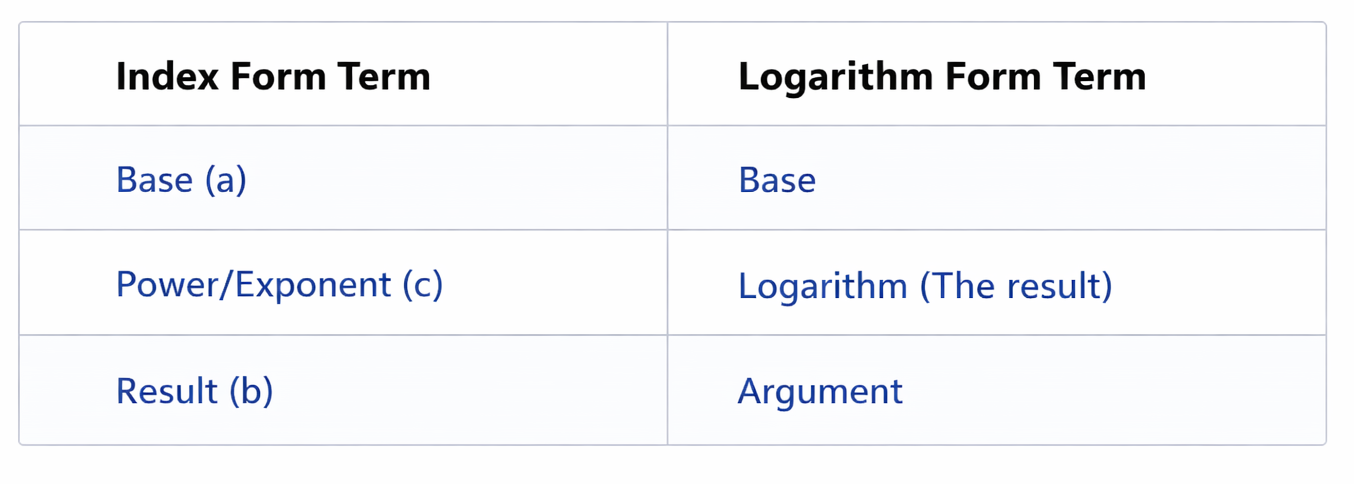
For better Understanding, Check out The Table below :
It summarizes The Difference Between Logarithm Forms and Exponent Form (Index Notation)
Exponent Form (Index Form) : $\boldsymbol{a^{c} = b}$
Logarithm Form : $\boldsymbol{\log_{a}(b) = c}$
Examples
(i) $\boldsymbol{2^{3} = 8}$
👉 $\boldsymbol{\log_{2}(8) = 3}$
(ii) $\boldsymbol{10^{2} = 100}$
👉 $\boldsymbol{\log_{10}(100) = 2}$
(iii) $\boldsymbol{3^{3} = 27}$
👉 $\boldsymbol{\log_{3}(27) = 3}$
Sample Questions
Attempt the following Questions:
1. Convert to exponential form:
$\boldsymbol{\log_{2} 8 = 3}$
2. Convert to logarithmic form:
$\boldsymbol{5^{2} = 25}$
3. Convert to exponential form:
$\boldsymbol{\log_{10} 1000 = 3}$
4. Convert to logarithmic form:
$\boldsymbol{3^{4} = 81}$
5. Convert to exponential form:
$\boldsymbol{\log_{4} 16 = 2}$
Check The Answers Below:
TAKE NOTE :
When Converting Logarithms to Exponents and vice versa :
- The base stays the base: The small number at the bottom of a logarithm always remains the main large number (the base) when you switch to index form.
- The answer and the power swap: When moving between forms, the number that was the "answer" in one form becomes the "power" in the other.
- Logs always find the exponent: Remember that a logarithm is simply a mathematical way of asking "to what power" a number must be raised.
- Arguments must be positive: You can only take the logarithm of a positive number; you cannot have a log of zero or a negative number.